DoLadu

Offline QA for 3D projects · Windows

Your FBX has
flipped normals.
Your DCC says it's fine.

Unreal disagrees. Usually the night before handoff.

DoLadu scans the whole project in one pass and scores it out of 100 — then fixes what it found. It runs on your machine, with the network cable out.

No account, no cloud, no telemetry Windows · one file Licence, not a subscription to a cloud
SCROLL

The expensive part

The problem was never
the modelling.

It's the fifty small things between “done” and “delivered”. A normal map in the wrong colour space. Two textures at 4K that should be 1K. A pivot that isn't at the origin. Naming that passes your eye and fails the importer.

None of them are hard to fix. All of them are hard to find — and you find them at the worst possible moment, in someone else's engine, with your name on the file.

Project Audit · Hero_Character
0 / 100 Minor issues
Naming conventionMatches UE profile
NormalsWinding uniform
UVs · texel densityWithin target
Pivot at originOffset 4.2 cm
Texture sizes2 at 4K, should be 1K
Colour spaceT_Skin_N · sRGB, expected Linear
Duplicates · scaleClean · centimetres
Every finding names the file and offers the fix as a button

One pass

One scan.
One number.
Then the list.

Point it at a project folder. It reads every mesh and every texture once, then scores the project out of 100 across naming, normals, UVs, texel density, texture sizes and colour space, duplicates, pivots, scale, collision meshes and lightmap UVs.

The score is the headline. The list under it is the work — every finding names the file, says what's wrong, and offers the fix as a button.

DoLadu findings: mesh over budget with pivot off origin, and the fix buttons beside them
Screenshot slotdoladu/assets/shots/audit.jpg
Findings — each one names the file, and the fix sits next to it.

The difference

It fixes what it found.

Repack ORM. Convert rough ↔ gloss. Resize to power-of-two. Rename to the UE convention. Move pivots to origin. Flip a normal map's green channel. Batch-convert formats.

Every destructive step is journalled. One command puts it all back — including the batch you ran twenty minutes ago.

Safe mode is on by default: results go to copies, your originals are never touched until you say so.

Measured · 2 meshes / 19 textures
First scan 2.86 s
Every tool after 0.06 s
Re-read 0.001 s

Measured on a real character, not estimated.

Speed

Fast because
it reads once.

The first scan is cached. Every other tool reads from that cache instead of touching the disk again.

That's the difference between a tool that stalls the app every time you click something, and one that answers instantly.

The workspace

Built like a workspace,
not a wizard.

Nine workspaces, one project. Each one opens on what it's for and remembers where you left it.

Inspector

The things a viewport
won't show you.

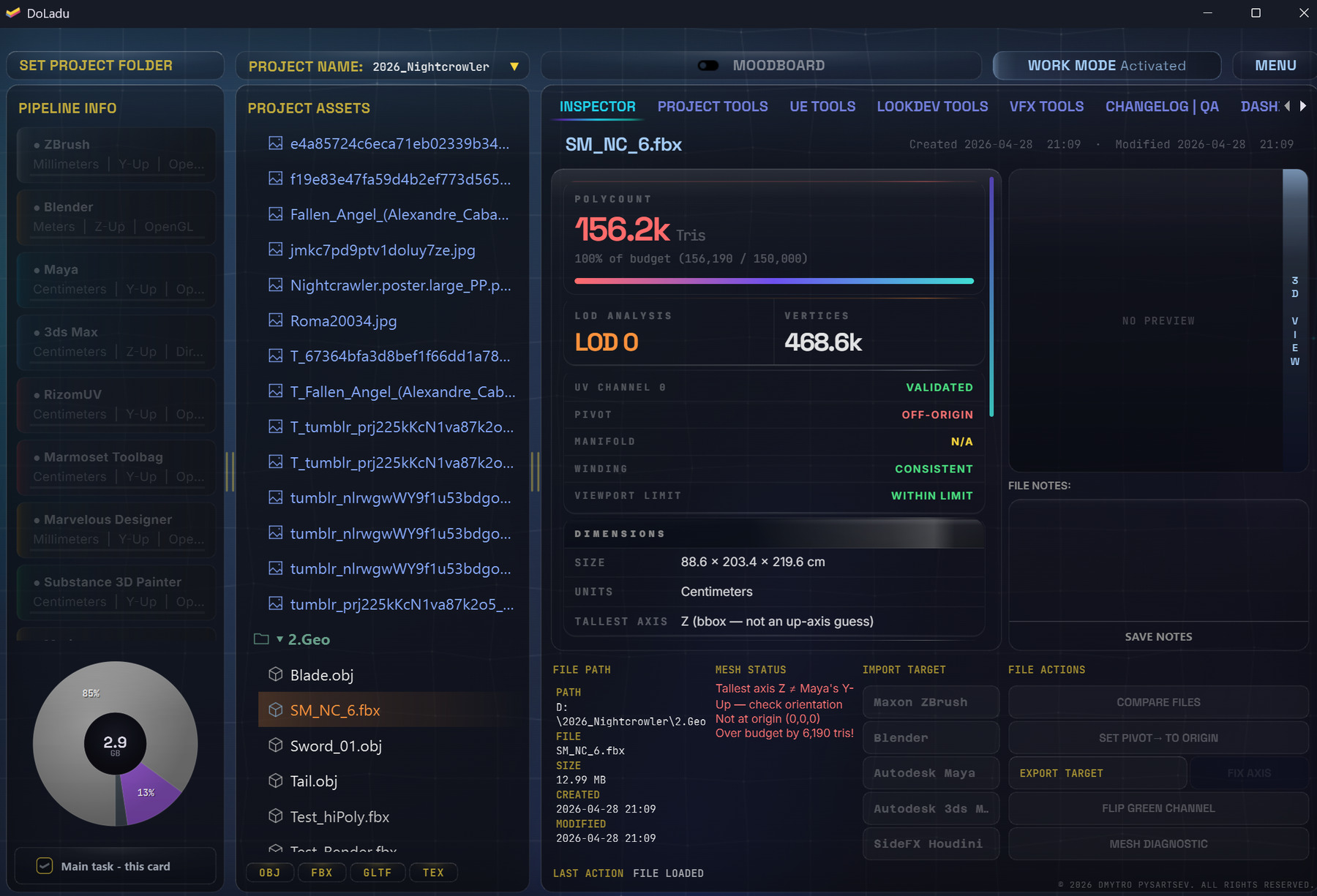
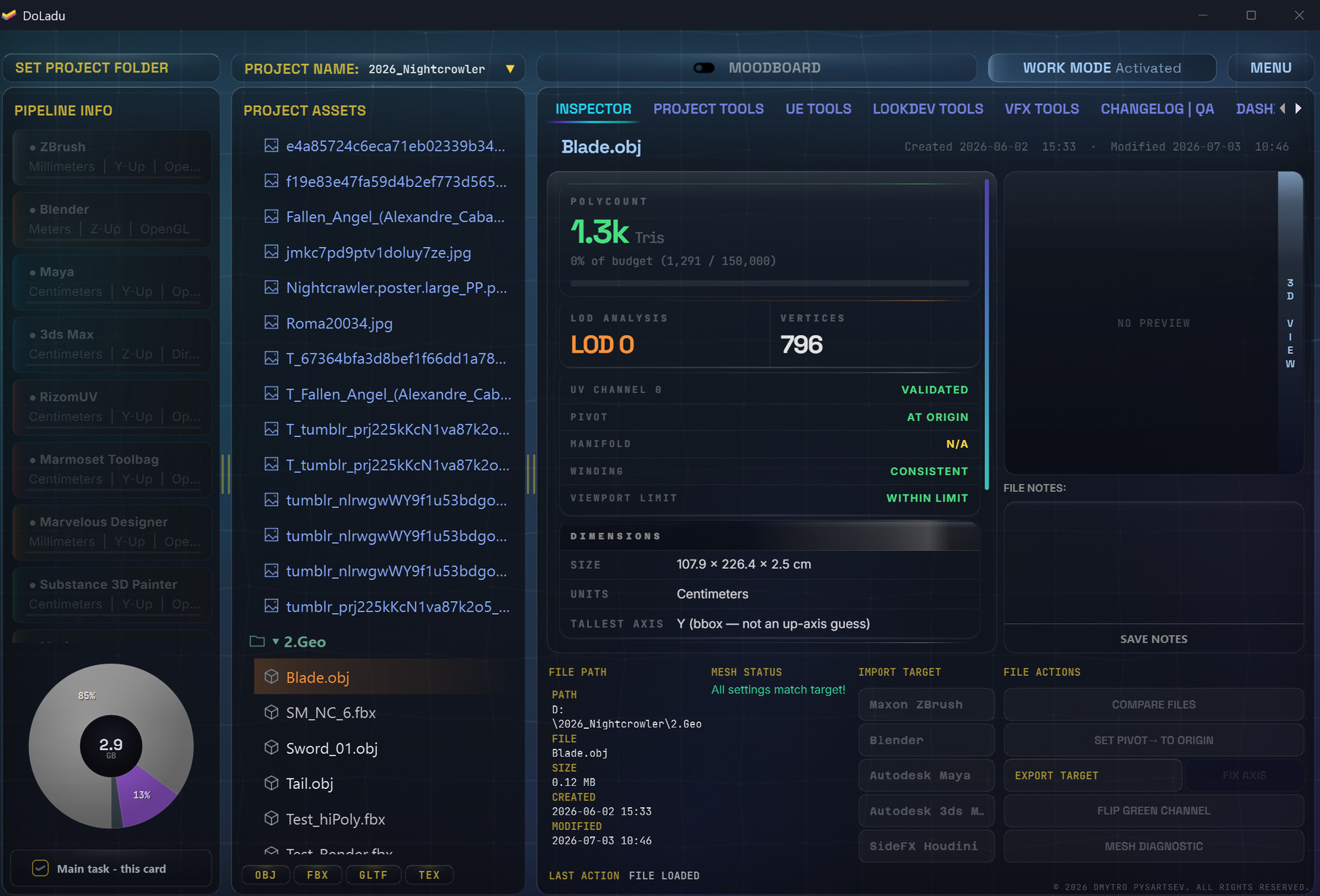
Load a mesh and get wireframe, UV and normal overlays, hard edges and open shells — next to the numbers that decide whether it ships: poly count against your budget, pivot at origin, winding consistency, units and bounds.

Solves “it looked fine in Maya”.
Project Tools

The batch floor.

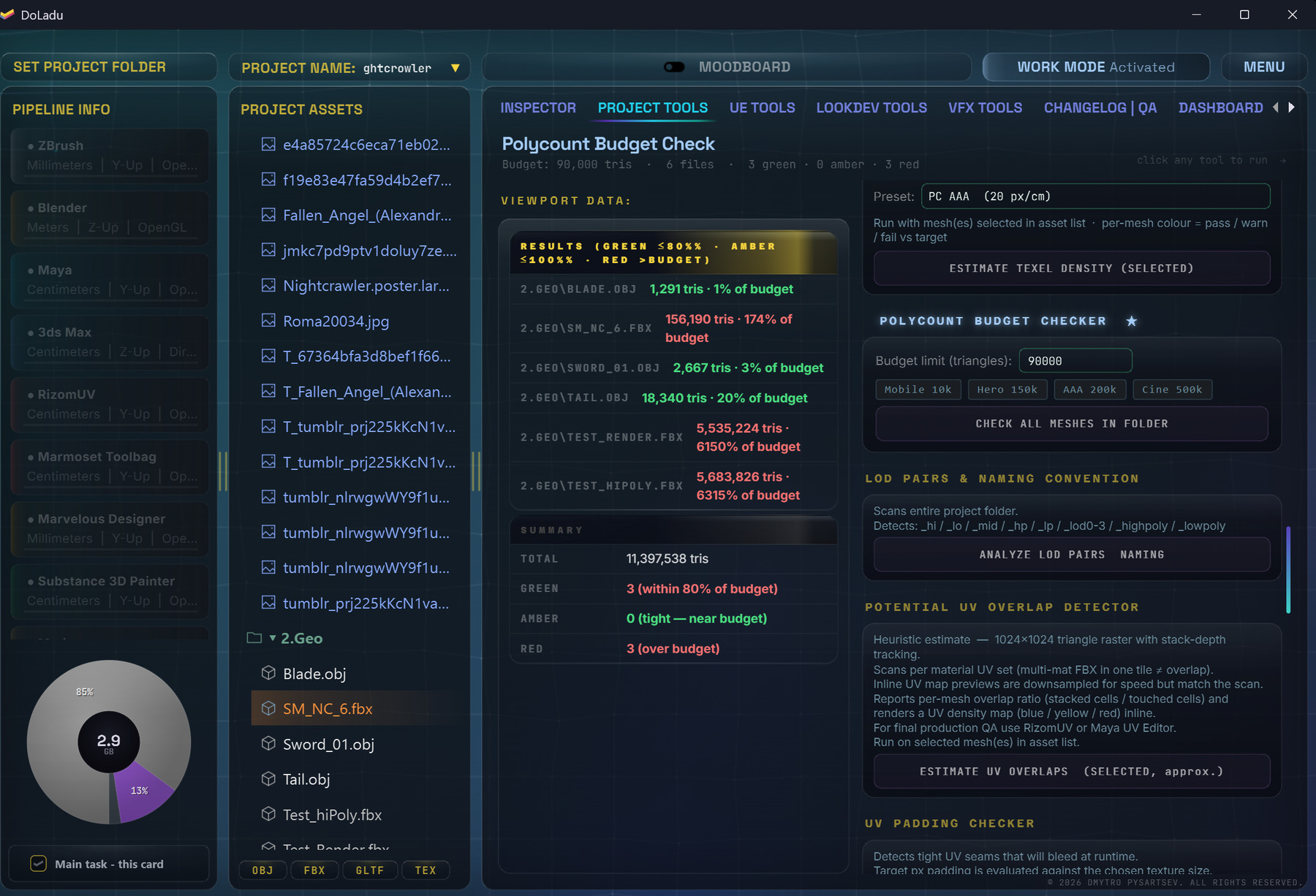
Duplicates, texture sets, renaming, resizing, format conversion, snapshots — run across the whole project at once, with a polycount budget check that shows you every mesh against the limit in one list.

Solves the hour you spend renaming files by hand.

UE Tools

Checked before
the importer sees it.

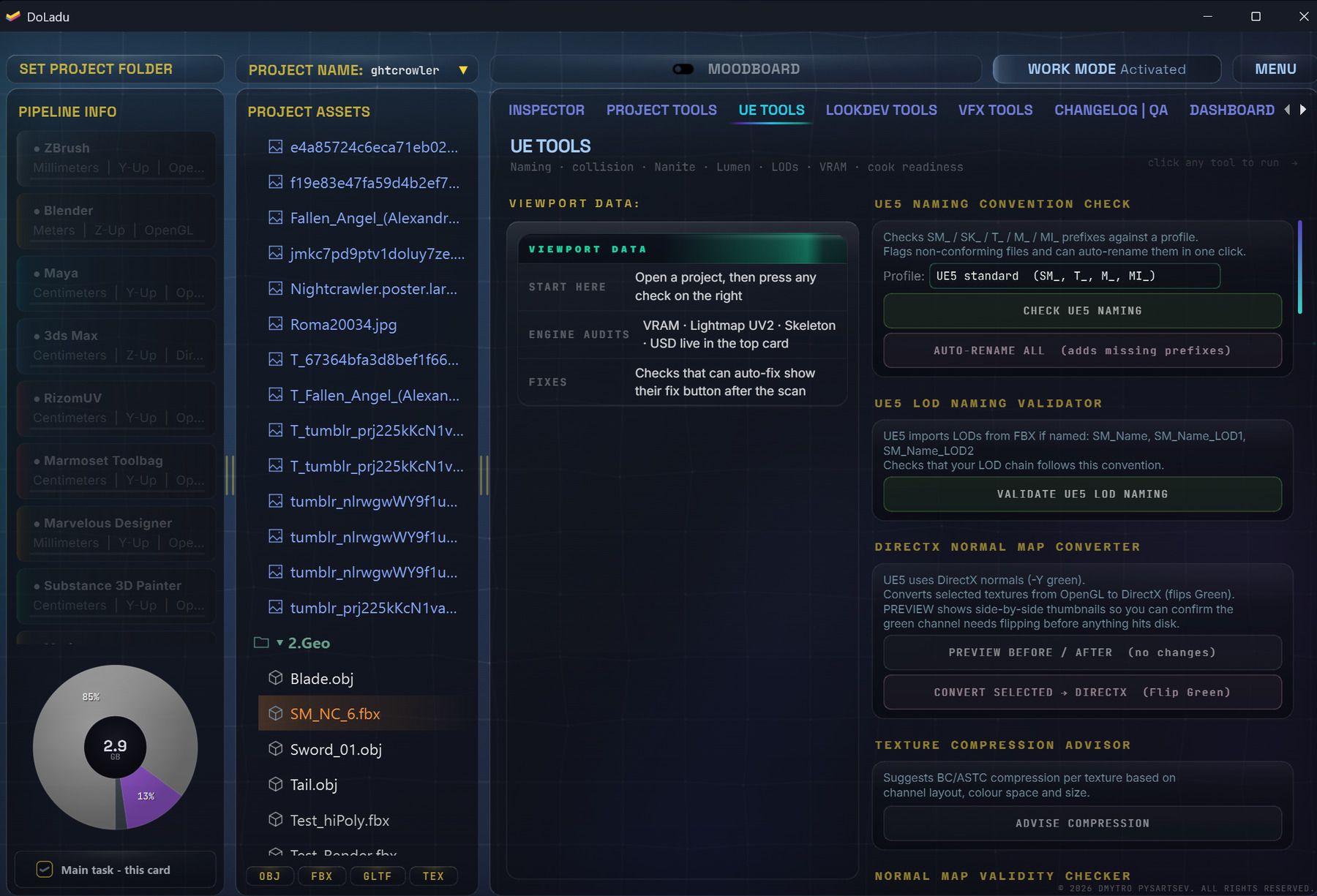
Nanite and Lumen eligibility, lightmap UVs, collision meshes, texture VRAM against a budget, UE naming with one-click auto-rename, and a DirectX/OpenGL normal converter that shows before and after rather than asking you to trust it.

Solves the import that silently does nothing.

LookDev Tools

Stop guessing
light values.

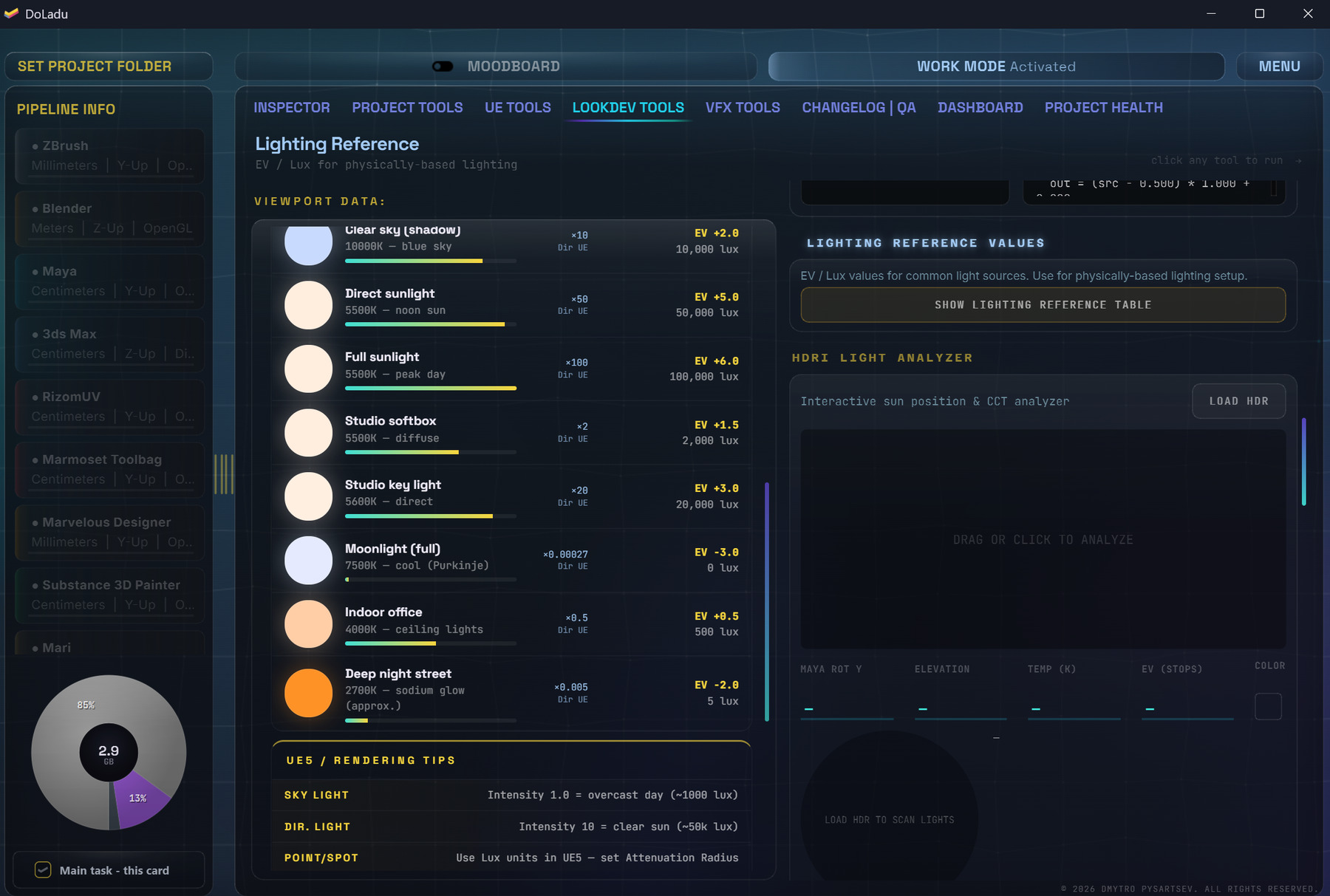
Exposure, FOV, depth of field, Fresnel curves, F0/IOR, albedo range — the numbers you paste into the engine. Plus real EV and Lux figures for clear sky, direct sun, softbox and moonlight, and an HDRI analyzer that finds the brightest point and gives you sun position and colour temperature.

Solves the afternoon spent matching a plate by eye.

DoLadu Inspector tab
Screenshot slotdoladu/assets/shots/inspector.jpg
Inspector — budget, topology and metadata on one screen.
DoLadu Project Tools tab
Screenshot slotdoladu/assets/shots/project-tools.jpg
Project Tools — the whole project checked at once.
DoLadu UE Tools tab
Screenshot slotdoladu/assets/shots/ue-tools.jpg
UE Tools — naming, LODs and normal maps, validated before import.
DoLadu LookDev Tools tab
Screenshot slotdoladu/assets/shots/lookdev.jpg
LookDev — EV/Lux reference and HDRI analysis, in the same window.

What one scan covers

Ten checks,
one pass over the folder.

Files checked against a naming profile — prefixes, texture suffixes, packed maps — with auto-rename for everything that doesn't conform. Duplicate assets and oversized files surfaced in the same pass, so you find the copy of a copy before it ships with the rest.
Winding consistency, so flipped faces are named rather than discovered in engine. Green channel direction for DirectX against OpenGL, with a before/after preview. Colour space per map — a normal map sitting in sRGB is caught here, not in a lighting review.
UV channel validation with the UDIM grid, overlap detection, and a texel density heatmap across the mesh measured against your target rather than against a guess. Lightmap UVs checked separately, because the engine treats them separately.
Pivot position against origin, units and bounding box in centimetres, up-axis read from the geometry rather than assumed, and collision meshes checked for the naming and shape the engine expects. A units and axis reference for twelve programs sits beside it, because that mismatch is where most broken exports begin.
Texture sizes against what the asset actually needs, power-of-two compliance, clipped blacks and whites, and total VRAM for the set measured against a budget you set. Full-depth EXR and 16-bit textures go through OpenImageIO, so a 16-bit normal map stays 16-bit.

Moodboard

Reference boards
that do something.

Four boards per project. Drop images, notes, colour tags and strokes on an infinite canvas.

Every board extracts its own palette and exports .ase — the swatches open straight in Photoshop and Substance. The colour tags carry the hex, and you can select the code and copy it.

It's the reference wall you already keep, except it lives with the project and feeds the rest of the app.

Separately, Atlas is the manual that ships inside the app — what every tool does and when to reach for it, without leaving the window.

Privacy

Nothing leaves
your machine.

No account. No cloud. No telemetry. It works with the network cable out.

The only time DoLadu talks to the internet is to check your licence — and if the server is unreachable, it keeps working for two weeks while it retries. An outage on our side is not your problem.

Your project never uploads anywhere, because there is nowhere for it to go.

Formats

Reads what
you already have.

MeshesFBX · OBJ · GLB/glTF · USD · Alembic · PLY · STL
TexturesPNG · TGA · TIFF · PSD · EXR · HDR
CachesVDB · Alembic

Full-depth EXR and 16-bit textures go through OpenImageIO, so a 16-bit normal map stays 16-bit.

Pricing

The year costs
six months.

Monthly

€29.99/ month

For one project. Cancel any time.

Best value

Yearly

€179.99/ year

The year costs six months — save €179.89.

Indie

€599.99/ year

5 seats — €120 per artist, per year.

Sold through Lemon Squeezy, which handles VAT and invoicing as merchant of record.

Before you ask

The six questions I get most.

Only to check your licence. If the server is down, DoLadu keeps working for two weeks while it retries.
Not unless you tell it to. Safe mode writes to copies. Everything destructive is journalled and reversible with one command.
It stays 16-bit. Depth-sensitive operations go through OpenImageIO.
It reads files, not scenes — so it doesn't care whether they came from Blender, Maya, 3ds Max, Marvelous or Substance.
Windows only for now.
Yes. Sign out on the old machine, activate on the new one.

Minimum system requirements

What it needs
to run.

Operating systemWindows 10 64-bit, version 1809 or newer
Processor4-core x64 — Intel Core i5/i7 6th gen or AMD equivalent
Memory8 GB RAM
GraphicsAny GPU with OpenGL 3.3 / WebGL 2 support and current drivers
Storage1.5 GB free — about 950 MB for the program, the rest for project data
Display1280 × 800

Intel HD 520 and up will run, but the 3D viewer will feel slow on large meshes.

Get it

Find it now,
not the night before.

  • Runs on your machine — no account, no cloud, no telemetry.
  • A licence you own, not a subscription to someone else's server.
  • Sold through Lemon Squeezy, which handles VAT and invoicing as merchant of record.